There is now a wind farm proposal for the Mull of Kintyre. For further information please visit the website:
http://www.stopmullofkintyrewindfarm.com
The Wilderness Foundation UK supports the provision of energy from renewable sources, but will continue to raise awareness of schemes or proposals that may be detrimental to the environment for which they are proposed. The Foundation advocates the creation of wind farms offshore and in locales where there is established development. Each development has to be judged on its own merits and impact on the environment and as such we encourage informed debate on all issues affecting wilderness and areas of wild landscape. We believe it is our duty as an environmental educator to bring news of threats to these precious areas to a wider audience.
Tuesday, March 11, 2008
Stop Mull of Kintyre Wind Farm

Monday, September 17, 2007
Campfire Questions with Cameron McNeish
We wired Cameron McNeish, Wilderness speaker, editor of TGO Magazine and WFUK Trustee, to hear a bit more about what's going on in his end of the UK.
Here's the Q&A:
• You recently wrote on the TGO blog about 'The Wild Places', the new book by Robert Macfarlane – Could you tell us a little bit more about why our readers should check it out. Also, could you maybe give us an insight into what you discussed with Robert in your forthcoming podcast interview with him?
• What are the main lessons you’ve taken away from both book and interview?
Many folk will be familiar with Robert Macfarlane's book 'Mountains of the Mind'. It was published to wide critical acclaim a few years ago.
His new book, The Wild Places, was published earlier this month. Rather than focus on the kind of person who climbs mountains Rob has placed the spotlight on the landscape itself. In that sense it's the kind of book that Americans tend to write much better than we do, people like Barry Lopez, Edward Hoagland, Ed Abbey and Annie Dillard, not to forget, of course, the earlier writers like Muir, Emerson and Thoreau. In the UK we have a good legacy in mountaineering literature - We also have a reasonable legacy in "nature" or "wildlife" writing - I can think of people like Gavin Maxwell and Frank Fraser Darling, although today's wildlife writers are but a pale copy of these people.
Very few people, with possibly the exception of WH Murray and Jim Perrin, and perhaps one or two others, have ever written evocatively about our relationship with wild places, and why such landscapes are important to us, spiritually and emotionally, not to forget any bio-vidersity role they have.
I discussed these issues with Rob and also a little about his background - his grandfather, who lives in the Scottish highlands, was a very enthusiastic mountaineer and is a superb botanist. Rob was brought up in these traditions. We also discussed the need for writers like Rob to remind readers that wild places are a dwindling commodity, and that it is incumbent on all of us to protect them.
• Is it right that you’re thinking of doing more video – and if so, where will our readers be able to find it?Robert very gently reminded me of my own role as a conservationist.
In particular he shared a thought that very much resonated with me. He told me he'd had some criticism from natural history scientists and academics who claimed that he focused too much on the emotional/spiritual side of the great outdoors, rather than work to a stricter scientific analysis.
That thought reminded me of a conversation I once had with the late WH Murray, whose first book, 'Mountaineering in Scotland', had been returned to him by a prospective publisher because it was “too spiritual.”
I’m very aware of such criticism, much of which comes from academia and science-based naturalists. It’s as though the emotional, spiritual or experiential side of the outdoors is almost worthless and yet such emotions, I would suggest, are inherent in all of us.
They are, as the wilderness poet Gary Snyder once said: "perenially within us, dormant as a hard-shelled seed, awaiting the fire or flood that awakens it again." Perhaps we can be the fire or flood that has that affect on people?
• Now you’re a wild places not to mention wilderness speaker in your own right – where would we be able to hear you this autumn?I've made a couple of DVDs - The Wasdale Round and The Howgills, for a company called Striding Edge, run by my old friend Eric Robson. I'm also making a series of Wild Walks for a BBC Scotland monthly programme called the Adventure Show. That series will eventually appear on a DVD.
I've also been pretty involved in making audio podcasts for my own website at cameronmcneish.co.uk and for my magazine's website at tgomagazine.co.uk so it seems logical to move on from those audio podcasts to video podcasts. I've just bought a pro video camera and have been working hard trying to master the video editing software so hopefully, within the next 2 or 3 weeks, we'll have videos running on both websites.
Yes, the lecture season is just about to start and I'm off to the Isle of Arran for the Arran Walking Festival at the end of this month. That'll be followed with a talk in New Galloway, the Inverness Book Festival, two lectures for the Royal Scottish Geographical Society in Dunfermline and Edinburgh, the Edinburgh Mountain Film Festival. On top of that lot I'm giving the annual Snowdonia Society lecture in Bangor and I've been honoured to be asked to give the annual Wainwright Lecture on this the centenary of Wainwright's birth. All the dates and venues are on my website.• Give us a couple of top autumn reads that’ll broaden our mind.
Thanks Cameron - and best of luck with that hectic schedule!Well, you must read Robert Macfarlane's book, The Wild Places and I would urge anyone to look out the books of an American/Welsh writer called Colin Fletcher.
Colin died earlier this year but his book, The Man Who Walked Through Time, is the finest outdoor book I've ever read. It's about the first on-foot traverse of the Grand Canyon before it was flooded.
Read it and it will open your mind to the amazing geological timespan that formed one of the world's natural wonders, the Grand Canyon.
A couple of quick extra links not covered above:
- Wasdale clip (WMV format, 2.5MB)
- The Howgill Fells clip (WMV format, 7.9mb)
- BBC Scotland Outdoors
Tuesday, July 10, 2007
Speaking of Wilderness
We welcome enquiries for speaking engagements on the subject of Wilderness.
Jo Roberts, our director, is a seasoned speaker and debater, whether radio or conference keynote, at local or international level.
Hiker, backpacker, author and broadcaster ...and Wilderness Foundation Trustee, Cameron McNeish, also undertakes such engagements. Here are two of his Wilderness dates for your diary:
Saturday Sept 29: Wild Scotland - A Spirit of Place; Arran Walking Festival, Isle of Arran
Tuesday Oct 2: Wild Scotland - A Spirit of Place; Inverness Book Festival, Eden Court Theatre, Inverness
You can also read The Wilderness World of Cameron McNeish (and find more talk dates + book him directly for your own event) - RSS feed here (if you're new to RSS feeds, watch this superb Common Craft video explaining RSS in Plain English - Then head over and give Google Reader a go and don't forget to add our feed too.
These are just two of the many great speakers we have on hand - Get in touch with our office if you need a passionate Wilderness speaker and we'll find the right person for your audience.
Monday, December 18, 2006
Walk the Talk...
The Wilderness Foundation supports the work of the Centre for Human Ecology - we thought this new initiative might be of interest:
"CHE and Openground take the sustainability message into the wilds - A new training course gets people out of the seminar room and into the mountains to explore sustainability and social justice. 'Walk the Talk' is a journey into Scotland's wild places where participants will be inspired by the natural world and will develop practical strategies for organisational change. Designed to support organisational learning in businesses, public agencies and more-than-profit organisations, Walk the Talk is a collaboration between Sam Harrison of Openground and Osbert Lancaster of the Centre for Human Ecology. Sam is a human ecologist and outdoor educator experienced in the transformative power of wild places. Sam explains "The power of Walk the Talk is way beyond a simple outdoor team building exercise. We leave behind dry facts and prophesies of doom that are so often the staple of the training room. Actively experiencing the natural environment inspires new thinking about our relationship with the ecosystems on which we - and our organisations - all depend." Osbert is the executive director of the Centre for Human Ecology. "If sustainability is already part of your organisation's strategy, Walk the Talk will take you to the next level," explains Osbert, "and if you're just starting to explore the issues it will start you on your journey with a clear view of the landscape and the tools to starting mapping the route ahead."Walk the Talk is currently in development, with pilot courses planned from April 2007."The Wilderness Foundation knows from direct experience how powerful learning in a wild setting can be - the Wilderness Leadership School in South Africa has over the years run a host of Opinion Leader Trails, including a programme for tailor made for South African MPs.
- Further information is available on the CHE website here.
- Read Andrew Muir's '99 article on this in the International Journal of Wilderness.
Monday, December 11, 2006
International Mountain Day: Wilderness Perspective
 Today's International Mountain Day - a celebration and opportunity to "reflect on the people who are directly affected by ecosystem degradation and climate change: mountain communities" as the IUCN says in their coverage.
The IUCN, who the Wilderness movement engages with and supports through the Wilderness Task Force, has been drumming up the debate around mountains with recent articles such as this one: 'Mountains Rise to Fight Climate Change'. The BBC's Planet Earth series also had an episode focusing on mountains. If you're in the UK you can re-view some of that content on-line here: http://www.bbc.co.uk/nature/animals/planetearth/hd/
On a linked but separate note, the forthcoming 2007 Mountain & Wilderness Medicine World Congress - which will bring together the Wilderness Medical Society (WMS) and the International Society for Mountain Medicine (ISMM) for their joint congress, migh also be of interest.
Wednesday, November 08, 2006
Trees for Life diary...
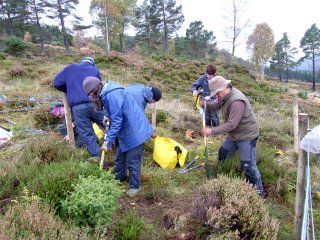
"I first met the rest of my group at Inverness train station, not knowing what to expect.You can learn more about Trees for Life on their website: http://www.treesforlife.org.uk/As individuals turned up I shook their hand and we exchanged names, and we travelled via the minibus to Glen Morrison, where our work week was based.
On the way we stopped in a small section of forest for lunch and an introductory talk. Although it was only a small piece of natural Caledonian forest, you felt as though you where in a Jurassic park film, with the river raging and the lichens dripping from the trees.
On the following Sunday we started work. We would be taking down an old, now redundant fence in Forestry Commission land. I didn't really know how important this was but many rare black grouse are killed by fences each year as they fly low to the ground and sometimes may not see the fence, especially in foggy weather which is common!
Monday we started to make aspen enclosures quite hign up in the glen. Aspen does not disperse its seed very well; in fact it rarely produces seed at all, so planting them is important recreate the natural forest diversity. Unfortunately deer like to eat aspen leaves so deer fences must be made to protect the saplings. It took almost a day for four of us to complete one enclosure.
Other days included a red squirrel survey: As many of you probably know the grey squirrel has take over from the red squirrel in most places; however in predominantly coniferous forest, reds have a slight advantage and still cling on. Cutting down non-indigenous tree species is another important task. Sitka spruce in particular seeds vigorously and if left as they are they would out-compete birches, Scots pine and others, eventually killing them. In the evenings a couple from the group would cook a meal, which every day was great, followed down with a "wee dram" of single malt. Lovely. One of my favourite experiences was listening to a certain owl that lived somewhere in a small stand of lime trees near our accommodation, despite my best efforts of trying to spot it in the dark, I was reduced to just listening, for me it was a rare sound. It was certainly a great week for me and the others and would recommend it to anybody, the variety of people in my group was very broad!" - Jason Cheng